
1. Canada’s Marginal Effective Tax Rate (METR) and Fiscal Policy
A Marginal Effective Tax Rate (METR) quantifies the overall
tax burden associated with an additional dollar of income or investment,
taking into consideration all pertinent taxes and deductions. It indicates the
actual tax paid at the margin, rather than merely the statutory or average tax
rate. It is the marginal tax rate, not the average tax rate, most directly
affects economic incentives.
The METR is calculated as:

The METR includes income taxes (corporate and personal), payroll taxes, commodity taxes on inputs, accounting depreciation and deductions, as well as tax credits or incentives. It illustrates the genuine tax effect on economic choices such as investing, hiring, or increasing work hours. If a decision is to be made about the tax rate to support a fiscal policy, then to maximize its net benefit, the decision maker must select a value of the tax rate at which its marginal benefit equals its marginal cost.
Example (simplified):
If an investment is required to yield 10% before tax, but the investor only receives 7% after tax:

Thus, the marginal effective tax
rate is 30%, regardless of whether the statutory tax rate differs.
To enhance productivity and draw
in investment, the new government has announced in the budget that it is
implementing a Productivity Super-Deduction, a series of improved tax
incentives that encompass all new capital investments, enabling businesses to
immediately deduct a greater portion of the costs associated with these
investments. This initiative will also facilitate business investment and growth.
Under this initiative, companies
can expedite the recovery of their investment costs via the tax system. This
approach renders investing in machinery, equipment, technology, and other
assets that boost productivity more appealing, thereby enhancing Canada’s
competitiveness in attracting investment.
The productivity super-deduction
is set to lower Canada's Marginal Effective Tax Rate (METR) by over two
percentage points, thereby enhancing Canada’s competitive edge against the U.S.
considering the initiatives introduced in the One Big Beautiful Bill Act
(OBBBA). Furthermore, the 2025 budget indicates that Canada will achieve the
lowest METR among G7 nations and will fall below the OECD average. This
development indicates that businesses will find it easier to invest and expand.
With exception to transportation and storage, Canada exhibits a lower Marginal Effective Tax Rate (METR) compared to the United States. The 2025 budget indicates that this is indicative of the value-added taxes implemented at the federal level and in the majority of provinces across Canada, as opposed to the retail sales taxes that are prevalent in the U.S. Additionally, Canadian provinces are in complete alignment with federal expensing policies and, in certain instances, utilize their own investment tax incentives, thereby enhancing their competitiveness. The below chart is reproduced from the 2025 Federal Budget report showing Canada's sectoral marginal effective tax rates are very competitive compared to those in the U.S., 2025 (with exception to transportation and storage).
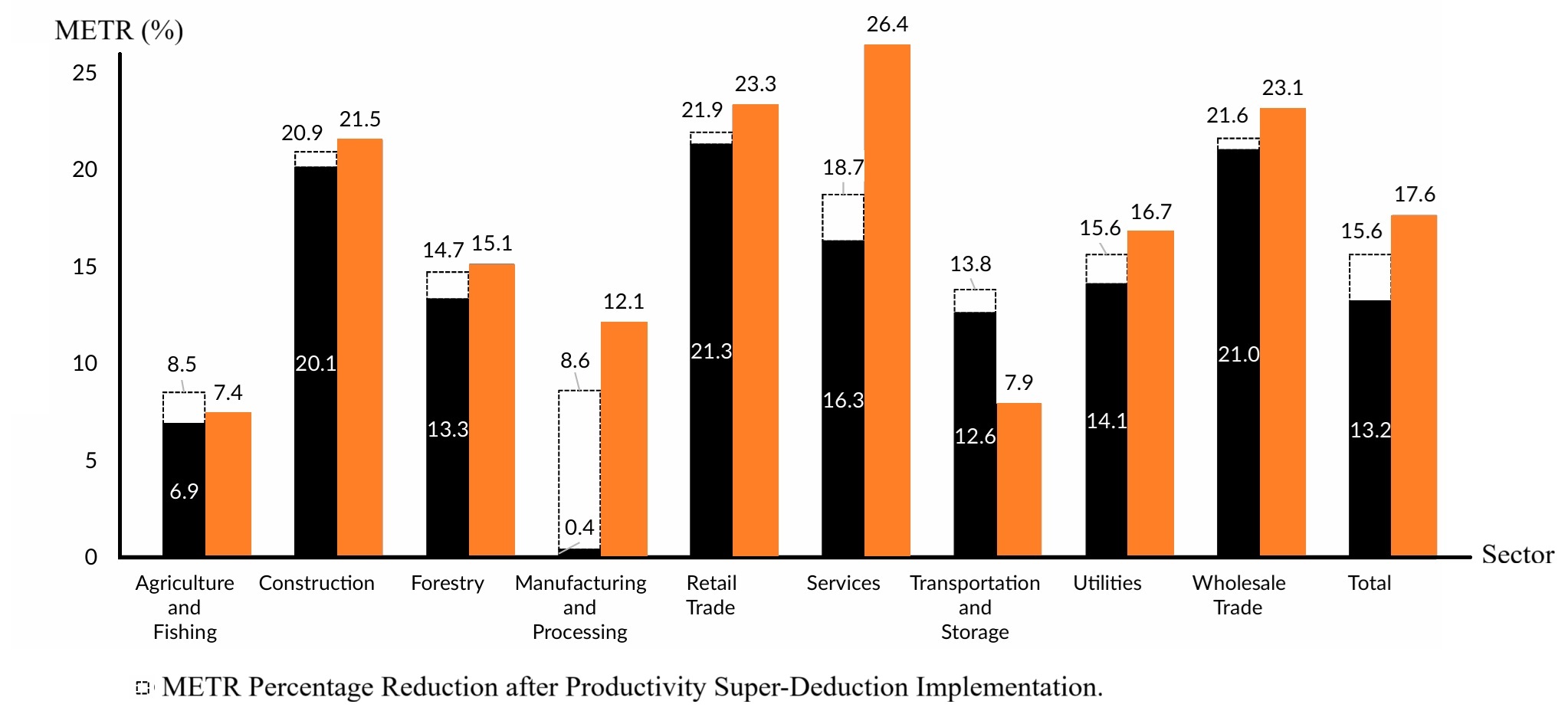
– Figure 1.
Canada’s 2025 sectoral marginal effective tax rates compared to the USA.
Source:
2. Implementation of a Reverse Charge Mechanism to Address Carousel Fraud
Under the GST/HST System
The budget indicates the government’s
planned implementation of a reverse charge mechanism under the Goods and
Services Tax / Harmonized Sales Tax (GST/HST), initially targeting the
telecommunications sector. This measure is intended to disrupt carousel fraud
schemes that have resulted in substantial revenue leakage and compliance
distortions in Canada’s indirect tax system.
Carousel fraud, as observed in
the European Union, and other jurisdictions with value-added tax systems,
exploits the input tax credit (ITC) mechanism by enabling fraudulent entities
to collect GST/HST on taxable supplies without remitting the tax to the
government, while intermediaries down the supply chain claim the input tax
credits on those same transactions. The telecommunications sector, particularly
the wholesale trading of digital and bandwidth services, has proven vulnerable
because transactions are high in value, rapidly executed, and often occur among
entities operating across multiple jurisdictions.
Applying the reverse charge
mechanism to this sector was announced in the budget as a targeted and
proportionate response. By shifting the tax liability from the supplier to the
recipient, the opportunity to extract unremitted GST/HST at the supplier level
is significantly reduced. This mechanism has demonstrated effectiveness in
comparable tax systems, especially when introduced alongside clear
administrative guidance and robust validation controls.
To ensure successful implementation, the following
considerations are expected to be implemented in the Excise Tax Act (ETA) and
technical guidance notes:
1.
Clear Scope Definition
The ETA and technical guidance
should precisely define which telecommunications supplies fall under the
reverse charge to avoid ambiguity and reduce administrative disputes.
2.
Registration and Due
Diligence Controls
Strengthened supplier and
purchaser verification protocols, particularly for entities newly registering
for GST/HST, will help prevent entry of shell companies used in carousel
chains.
3.
Transition Support and Timely
Public Advance Rulings
Industry participants, including
carriers, resellers, and brokerage intermediaries, require authoritative
guidance to adjust invoicing, accounting systems, and contractual terms. Small
and mid-sized telecommunications resellers and service aggregators may require
tailored guidance to update invoicing, accounting systems, and tax reporting
practices.
4.
Monitoring and Review
Framework
A periodic review mechanism
should be established to evaluate compliance effectiveness and consider staged
expansion to other high-risk sectors if warranted.
The announced step represents a constructive move toward protecting Canada’s tax base while promoting fairness for compliant businesses. With careful execution and transparent communication, it can serve as a model for combating sophisticated GST/HST fraud across additional industries.
For more information or inquiries kindly reach out to us at insights@dominionaudit.com.
Works Cited
Government of Canada. 2025. Canada Strong Budget
2025. Department of Finance Canada, Department of Finance Canada. Accessed
11 09, 2025. https://budget.canada.ca/2025/report-rapport/pdf/budget-2025.pdf.