
1. Overview
This article provides a comprehensive overview of accounting standards for property, plant, and equipment (PPE), emphasizing their importance in both financial reporting and sales tax treatment. The article compares three major accounting frameworks—U.S. GAAP (ASC 360), Canadian ASPE Section 3061, and IFRS IAS 16—showing that while they share common principles, such as capitalizing costs that provide future economic benefits, they also have some differences, particularly in flexibility of measurement (e.g., IFRS revaluation model). The key focus of the article is the treatment of sales taxes in determining asset cost. Through practical examples, it demonstrates that recoverable taxes (such as GST/HST in Canada) are excluded from asset cost, while non-recoverable taxes (such as certain U.S. sales taxes or Canadian provincial taxes) are included. Overall, the article illustrates how proper classification of costs, including sales taxe, ensures accurate asset valuation and compliance with accounting standards.
2. Property, Plant, and Equipment Accounting Standards
Companies that rely on equipment
to generate revenue must make important decisions about what type of equipment
to acquire, how long to retain it, and how well to maintain it. These decisions
directly affect operational efficiency and financial reporting, including
implications for sales tax returns. Plant assets—also known as property, plant,
and equipment or fixed assets—are long-term resources with three key
characteristics: they have physical substance, are used in the operations of a
business, and are not intended for sale to customers. Because of their
long-term nature, proper accounting for these assets is essential to accurately
report sales taxes.
Under the historical cost principle, plant assets are recorded at their cost, which includes all expenditures necessary to acquire the asset and prepare it for its intended use. This cost then serves as the basis for accounting over the asset’s useful life, including depreciation and potential impairment. Different accounting frameworks provide guidance on how to treat these assets, including ASC 360 Property, Plant, and Equipment under U.S. GAAP, ASPE Section 3061 under Canadian standards for private enterprises, and IFRS IAS 16 under international standards. Each of these frameworks outlines the recognition, measurement, and disclosure requirements for plant assets, ensuring consistency and transparency in financial reporting.
2.1.
ASC 360 Property, Plant,
and Equipment
Under ASC 360 Property, Plant,
and Equipment, the cost of plant assets is determined using the historical cost
principle, which requires that assets be recorded at the amount incurred to
acquire them and prepare them for use. This includes not only the purchase
price but also all directly attributable costs necessary to bring the asset to
its intended condition and location. Examples of such costs include delivery
and transportation charges, installation fees, testing costs, and any
professional fees related to acquisition. The goal is to ensure that the
recorded cost reflects the total investment made to make the asset operational
In addition, ASC 360 Property,
Plant, and Equipment requires that companies capitalize these expenditures as
part of the asset’s cost rather than expense them immediately, provided they
yield future economic benefits. Costs incurred after acquisition are only added
to the asset’s carrying amount if they improve the asset’s performance, extend
its useful life, or enhance its value. Otherwise, routine maintenance and
repairs are expensed as incurred. This approach ensures that the cost of plant
assets is measured consistently and allocated appropriately over their useful
lives through depreciation
2.2.
ASPE Section 3061
Under ASPE Section 3061 Property,
Plant and Equipment, the cost of plant assets is also determined based on the
historical cost principle, meaning that assets are recorded at the amount of
consideration given to acquire them. This cost includes the purchase price as
well as all directly attributable expenditures necessary to bring the asset to
the location and condition required for its intended use. Such costs may
include transportation, installation, site preparation, and professional fees.
When assets are constructed internally, the cost includes direct materials,
direct labor, and an appropriate portion of overhead costs. The objective is to
capture the full cost of acquiring and preparing the asset for productive use
In addition, ASPE Section 3061
Property, Plant and Equipment requires that only expenditures that provide
future economic benefits be capitalized as part of the asset’s cost. Costs
incurred after acquisition are added to the carrying amount of the asset only
if they enhance its productivity, extend its useful life, or improve its output
quality. Otherwise, routine repairs and maintenance are expensed as incurred.
Any discounts or rebates reduce the recorded cost, while asset retirement
obligations, when applicable, are also included in the asset’s initial
measurement. This approach ensures that plant assets are measured reliably and
that their costs are allocated systematically over their useful lives
2.3.
IFRS IAS 16
Under IAS 16 Property, Plant and
Equipment, the cost of plant assets is determined at initial recognition based
on the historical cost principle. This cost includes the purchase price, net of
trade discounts and rebates, as well as any directly attributable costs
necessary to bring the asset to the location and condition required for it to
operate as intended by management. Examples of such costs include delivery and
handling, installation, site preparation, testing, and professional fees.
Additionally, IAS 16 requires the inclusion of the initial estimate of
dismantling and restoration costs—known as asset retirement obligations—when
the entity has a present obligation to incur such costs
Furthermore, IAS 16 Property,
Plant and Equipment specifies that only expenditures that generate future
economic benefits are capitalized as part of the asset’s cost. Subsequent costs
are added to the carrying amount only if they enhance the asset’s performance,
extend its useful life, or improve the quality of output; otherwise, they are
expensed as incurred. Unlike some other frameworks, IAS 16 also allows entities
to choose between the cost model and the revaluation model after initial
recognition, although the initial measurement is always based on cost. This
approach ensures that plant assets are measured reliably and consistently while
providing flexibility in subsequent valuation
3. Computation of Plant Asset Cost with Recoverable Sales Taxes
3.1.
Example 1
A GST/HST registrant company located in Ontario purchases factory machinery in 2026 from a GST/HST registrant supplier at a cash price of $50,000. Related expenditures are harmonized sales tax at 13% of $6,500, insurance during shipping $500, and installation and testing of $1,000. The cost of the factory machinery is $51,500, computed as follows:

Since paid HST was 100% related to commercial activities, the purchaser can claim it back in their next GST/HST return as input tax credit (Line 106), and, therefore, is not part pf the machinery cost as per ASPE Section 3061.
4. Computation of Plant Asset Cost with Non-recoverable Sales Taxes
4.1.
Example 2
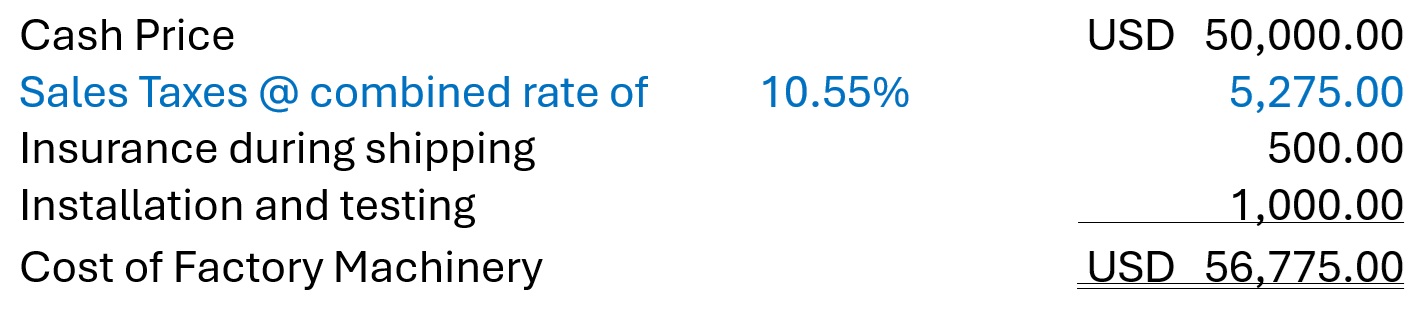
A company located in Seattle, Washington state purchases factory machinery in 2026 that does not fall under the state’s exempted machines used in specific manufacturing or research uses at a cash price of $50,000. Related expenditures are sales taxes at combined rate of 10.55% (6.5% state tax, a 0.0% King County tax, and a 4.05% local city / special tax) of $5,275, insurance during shipping $500, and installation and testing of $1,000. The cost of the factory machinery is $56,775, computed as follows:
4.2.
Example 3
A GST/HST registrant company located in Saskatoon, Saskatchewan purchases factory machinery in 2026 from a GST/HST registrant Ontario supplier at a cash price of $50,000. Related expenditures are Saskatchewan provincial sales tax at 6% of $3,000, goods and services tax at 5% of $2,500, insurance during shipping $500, and installation and testing of $1,000. The cost of the factory machinery is $54,500, computed as follows:

Since paid GST
was 100% related to commercial activities, the purchaser can claim it back in
their next GST/HST return as input tax credit (Line 106), and, therefore, is
not part pf the machinery cost as per ASPE Section 3061.
Works Cited
CPA Canada. n.d. ASPE Section 3061 Overview.
Financial Reporting Library.
FASB. 2009. 360 Property, Plant, and Equipment.
Norwalk, Connecticut: Financial Accounting Standards Board, September 15.
Accessed March 18, 2026. https://asc.fasb.org/360/tableOfContent.
Institute of Chartered Accountants in England and
Wales (ICAEW). n.d. IAS 16 Property, Plant and Equipment – Overview.
London. Accessed March 18, 2026.
https://www.icaew.com/technical/corporate-reporting/ifrs/ifrs-accounting-standards-tracker/ias-16-property-plant-and-equipment.
International Accounting Standards Board. 2001. IAS
16: Property, Plant and Equipment. London: IFRS Foundation, April.
Accessed March 18, 2026.
https://www.ifrs.org/content/dam/ifrs/publications/pdf-standards/english/2022/issued/part-a/ias-16-property-plant-and-equipment.pdf?bypass=on.
Weygandt, Jerry J., Paul D. Kimmel, and Donald E.
Kieso. 2018. Accounting Principles. 13th ed. Hoboken, New Jersey: John
Wiley & Sons, Inc.